
Dynamic Sketches: Hierarchical modeling of complex and time-evolving scenes Pauline Olivier
PhD Thesis, IP Paris, defended in March 2022
Manuscript: https://theses.hal.science/tel-03696747v1/document
Visual representations are essential to explore and communicate an idea or a phenomenon. As
digital software for 3D modeling and animation are still complex and specialized, they usually do
not favor creativity. In particular, they offer no easy way to quickly draft a series of alternative
options. Thus, up to now, sketching on a physical medium remains the only simple and general
means to create such representations. Recently, sketch-based modeling techniques were intensively
studied to create 3D models but only few techniques use sketching as input to create and immerse
the users into a 3D environment, guide the motion of shapes or explore hypotheses.
In this thesis, we focused on the real-time modeling of complex and time-evolving scenes
using only sketching as input. More precisely, the long-term vision would be to provide users
with an augmented pen enabling them to interactively create a 3D scene composed of shapes that
can be put into motion or deformed while enabling refinement both on the creation and motion
without any editing pipeline.
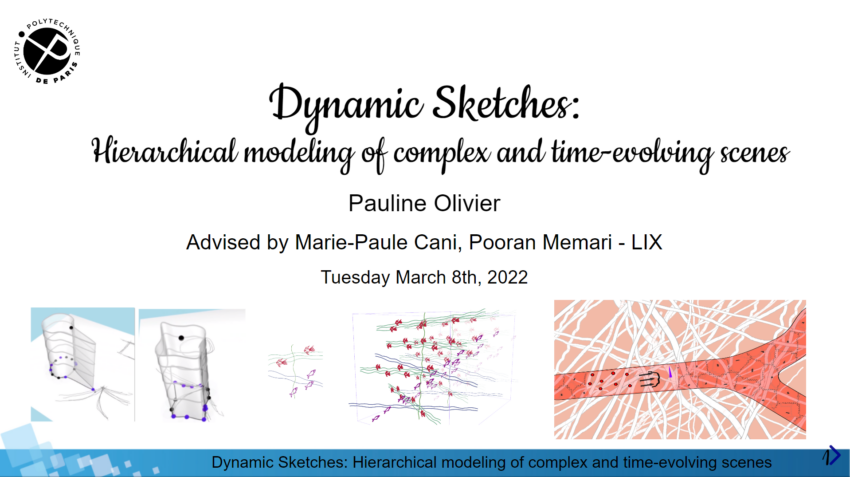
Through a collaboration with architects, we first introduce Nested Explorative Maps, a new
type of 3D sketch for the easy creation and exploration of ideas applied to the preliminary design of
man-made shapes. Our model enables coarse-to-fine sketching of nested structures to progressively
shape a 3D building from the floor plan to interior design while keeping the original strokes and
allowing interactive navigation through the alternative design that the sketch visually suggests.
We then tackle the synthesis of anisotropic distributions from a sketch as a means for the
general creation of content both in 2D and 3D. From a simple multi-resolution analysis of the
shape distributions, we propose an efficient method to synthesize the input distribution into an
extended 2D domain but also a 3D embedding of this extended distribution in addition to an
illusion of depth to enable users to immediately explore a 3D environment inspired by their sketch.
Finally, we collaborated with biologists to explore animated 3D sketches, where motions and
deformations of organic shapes can be expressed and refined through the use of a simple depiction
vocabulary inspired from standard representations in their field, and key-frame snippets.